


Pre-Snap Command and Boundary Arm Talent: CJ Carr’s 2025 Evolution and Growth
- marshall a
- Feb 23
- 4 min read

CJ Carr’s 2025 season put two traits on tape: pre-snap command that expanded over time, and boundary/vertical arm talent that let Notre Dame stress defenses from the far hash. The arc shows up clearly when you evaluate points from the beginning, middle and end of the year—and if you look at how the offense asked Carr to operate before the snap and where the ball went after it.

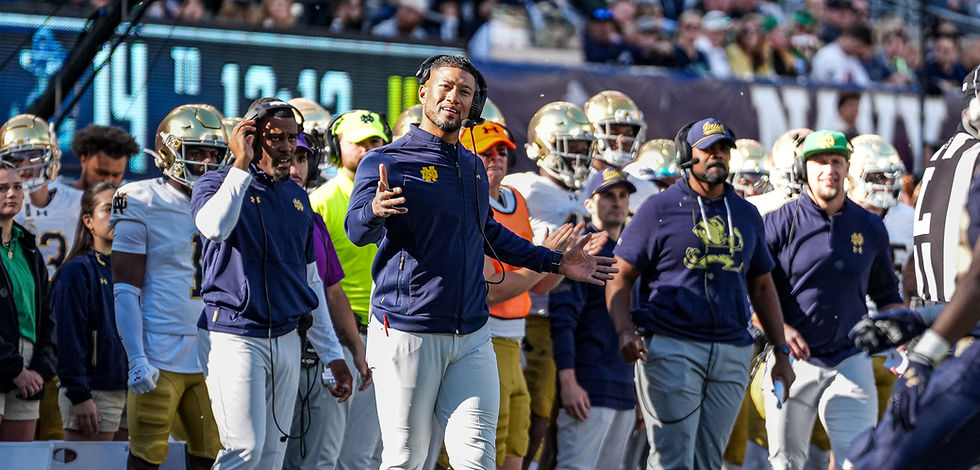
Photo by Maysum Hassanali
The Early-Season Baseline: Pre-Snap Routine Under the Microscope
Texas A&M became the early reference point because the conversation around Carr wasn’t only about his decisions but also about pre-snap information. Postgame reporting focused on a stance tendency that correlated with run versus dropback and gave the defense a cleaner pre-snap picture than Notre Dame wanted. Quarterbacks coach Gino Guidugli later acknowledged “tendencies,” described them as addressed, and framed it as a fix-and-move-forward item.
That week serves as a useful starting point. Carr still threw for 293 yards on 32 attempts against A&M. However, the offense had to spend part of the early season tightening the pre-snap operation—specifically, presentation, cadence consistency, and process—so defences received fewer tells before the ball was snapped.

Arkansas: The First Game Where “Command” Shows Up on the Drive Chart and the Throw Chart
Two weeks later, Carr’s trip to Arkansas marked the first game where the tape and the stat line both read “in control.” He went 22-of-30 for 354 yards with four touchdowns and no picks. UHND’s recap framed it as “Carr in Control” and pointed to the late-half sequencing that buried Arkansas: a short TD to Jeremiyah Love, followed by a 35-yard screen TD to Jadarian Price right before halftime.
From a quarterbacking standpoint, Arkansas is where the pre-snap layer becomes visible in the structure of the offense. You see more snaps where motion forces leverage and rotation tells, and you see Carr cash those tells quickly—screens into perimeter looks, intermediate concepts into favorable shells, and boundary shots when the corner’s leverage was inside or off, and safety depth invited it.
Arkansas is also the cleanest single-game evidence bank for Carr’s arm talent. Notre Dame very neatly packaged all 354 passing yards into a single “shortest to longest” compilation. And when you tag those throws, the recurring theme is stress: intermediate timing windows, movement out of the backfield, deep placement, and several opportunities to drive the football outside the numbers.
The Season-Wide Profile
Across 2025, he posted 63 completions of 15+ yards and 31 completions of 25+ yards. That’s enough volume to treat “medium-to-deep” as a defining trait rather than an occasional highlight, especially given the offense’s reliance on a 1A-1B run game with Love and Price. It is surely something that Freeman & Co. will gameplan around come this fall.
The next step is locating where those gains live on the field. For Carr, the most translatable subset is throws outside the numbers—far-hash outs/comebacks, boundary hole shots, and vertical sideline work—because those throws compress the defense’s margin for error. When your OC trusts you with those reads, defenses play on their back foot. And those throws correlate with his developed comfort pre-snap: protection communication has to be clean, and the picture has to be understood quickly, because boundary concepts are timing concepts.

November: The Late-Season Boundary/Vertical Throw Arrives with Efficiency
Boston College offers a late-season snapshot where the volume is modest, but the damage is heavy: Carr was 18-of-25 for 299 yards, two touchdowns, no interceptions. A review of the film shows many downfield throws, too, including a 44-yard touchdown to Will Pauling towards the seam and a 40-yard TD to Malachi Fields on a ball thrown with touch.
Those are the kinds of plays that show up when an offense, particularly Carr, Coach Guidugli, and Coach Denbrock are comfortable calling vertical concepts into the right shell and comfortable letting Carr execute with timing and placement.
Stanford, two weeks later, adds another late-season “toolbox” indicator: 205 yards on 27 attempts with two touchdowns, no picks, and a long of 54. The film value here sits in two categories: a deep completion that demands placement, and a handful of snaps where you can see pre-snap ID translate into post-snap answers—hot/replace throws, quick boundary access, or an intermediate concept triggered by a favorable leverage look. We would have seen more of the offensive scheme at play had Notre Dame been encouraged to widen the scoring margin, but the Committee suggested that need not be the case.
The Throughline: Expanded Pre-Snap Confidence Forces Defenses to Change Their Strategy
The season’s pre-snap story starts with an early tendency that drew attention and a coaching staff that treated it as correctable. It continues with a mid-September performance at Arkansas, where sequencing, tempo, and a wide menu of throws suggest an offense operating with clearer pre-snap information and Carr with more confidence. By November, the late-season efficiency games feature an increase in strikes down-the-field and consistent explosive production at a rate supported by every situational stat available.
That combination—pre-snap clarity plus a boundary-capable arm—shapes how defenses have to play Notre Dame in 2026. Corners can’t sit on the short stuff. Safeties can’t cheat into the run fit without exposing the sideline. Pressure packages have to win quickly, or they turn into leverage throws and explosives. And with the potential offensive line and Carr’s pre-snap read ability, pressure packages are a high-risk, high-reward wager for future DCs.
Want the latest intel on Notre Dame football? Subscribe to Tribune+ and get access to recruiting and team intel from The Irish Tribune team, as well as access to our intel community, exclusive app, and more Notre Dame content: Subscribe here to support our independent journalism.
Follow The Irish Tribune on social media:
Liked this story? Subscribe to our mailing list and get every story in your inbox.
Check out our Irish partners:
TMPR Sports - Use code "IrishTribune20" to get $20 off your officially-licensed Notre Dame pickleball paddle here!


Comments